Deforestation, siltation, storm-vulnerable coastlines, indigenous consent breached, and the deadliest country in Asia for land defenders — how ESG failure has hardened into the real ceiling on Philippine nickel's value-chain ambition.
For decades the country balanced mining revenue against ecological damage with an uneven hand. Compliance was demonstrably possible — the Rio Tuba nickel operation in Bataraza, Palawan, first shipping ore in the late 1970s, poured more than ₱920 million into environmental management between 2001 and 2015 and collected a national environmental award in 2016. But for the long tail of small and illegal operators, watershed destruction, siltation, and deforestation piled up as an ecological deficit that eventually forced a violent correction.
That correction arrived in 2016. The Department of Environment and Natural Resources (DENR) audited more than 40 metal mines and ordered 27 of them closed — 19 of which were nickel producers. Output cratered: national nickel production fell roughly 28.5% year-on-year, a swing of more than 100,000 tonnes. In February 2017, Environment Secretary Gina Lopez went further, suspending or closing some two dozen operations — including Nickel Asia's Hinatuan Mining Corporation — condemning open-pit extraction in blunt terms and moving to ban it outright for future contracts.
The lesson for markets was not the tonnage lost but the volatility revealed. A supply base that can lose a quarter of its output on a ministerial signature carries a political-risk premium that follows it into every offtake negotiation and every financing conversation.
The Philippines is a typhoon archipelago. Large open-pit laterite mining strips forest and coastal mangrove — precisely the natural defenses coastal communities rely on when storms arrive. The result is a recurring pattern: clear the slope, lose the buffer, and let the red silt run to the sea.
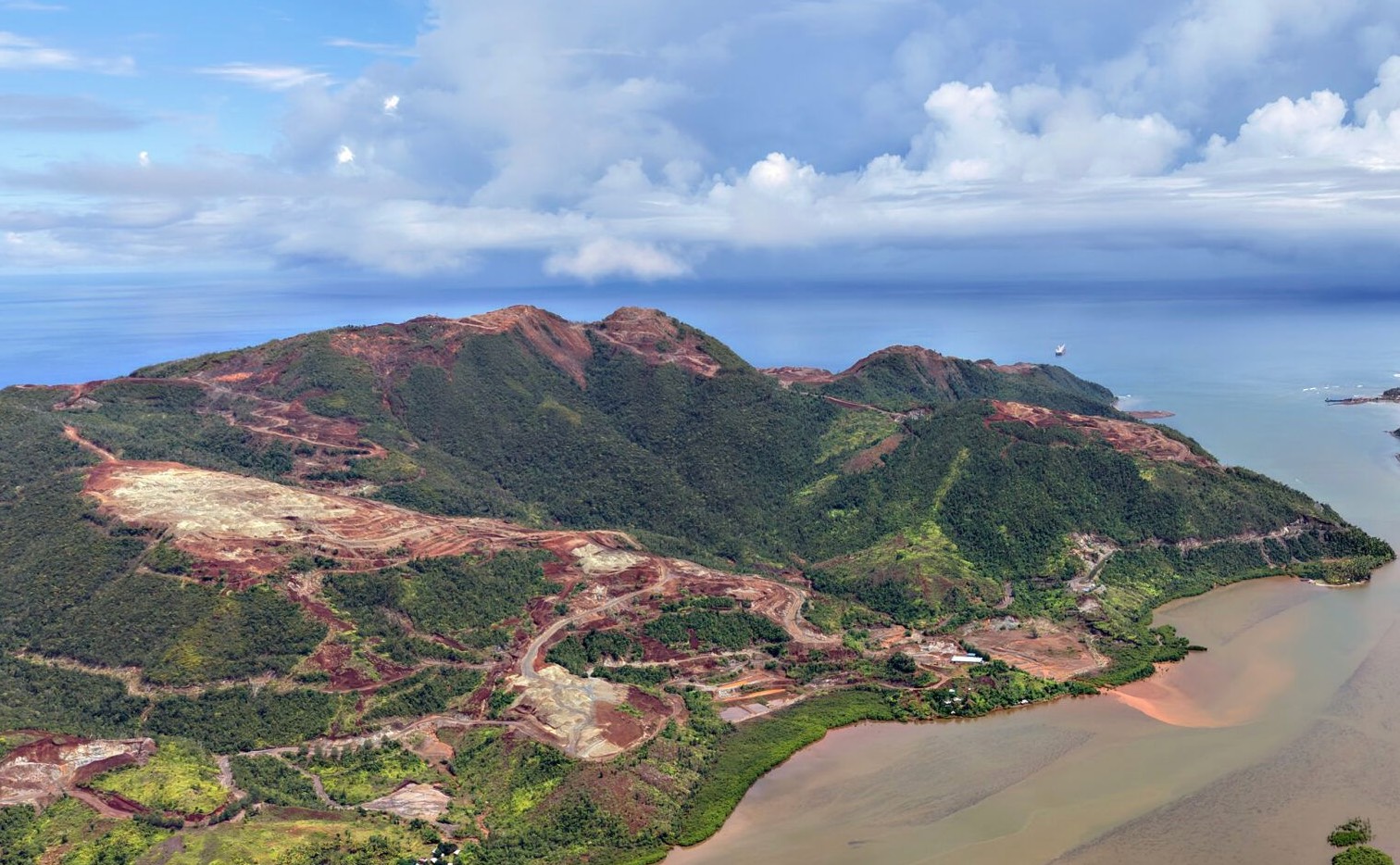
When super-typhoon Odette (Rai) struck in December 2021, hillside forest and shoreline mangroves in the Dinagat Islands had already been cleared for mining. Without those buffers, flooding and sediment runoff turned catastrophic. In Barangay Malino, mine tailings and red laterite poisoned the bay; crab fishers reported hauling up crabs so stunted their shells cracked open to reveal bodies packed with red mine slurry. Three years on, families who lost farmland and fishing grounds were still living under plastic tarpaulins — trapped in a loop of wrecked livelihood and food insecurity.
Near Cantilan, on Aayoki Island, land-based nickel mining flushed heavy red sediment into nearshore waters, killing the fish and shellfish that fed the village. When the seas grew too rough to sail out for a distant catch, residents described stretches of days surviving on breadfruit alone.

In 2023 the town of Brooke's Point in Palawan became a flashpoint. For roughly two months, hundreds of Indigenous Pala'wan tribespeople formed a human barricade against the Ipilan nickel operation — backed by Canadian-Philippine capital — which they said was extracting without complete permits. On 14 January, farmer Muharan Tamil described flooding that carried mine sediment into the bay and water system; downstream, broad stretches of rice paddy were smothered under red mud and the crop withered and died.
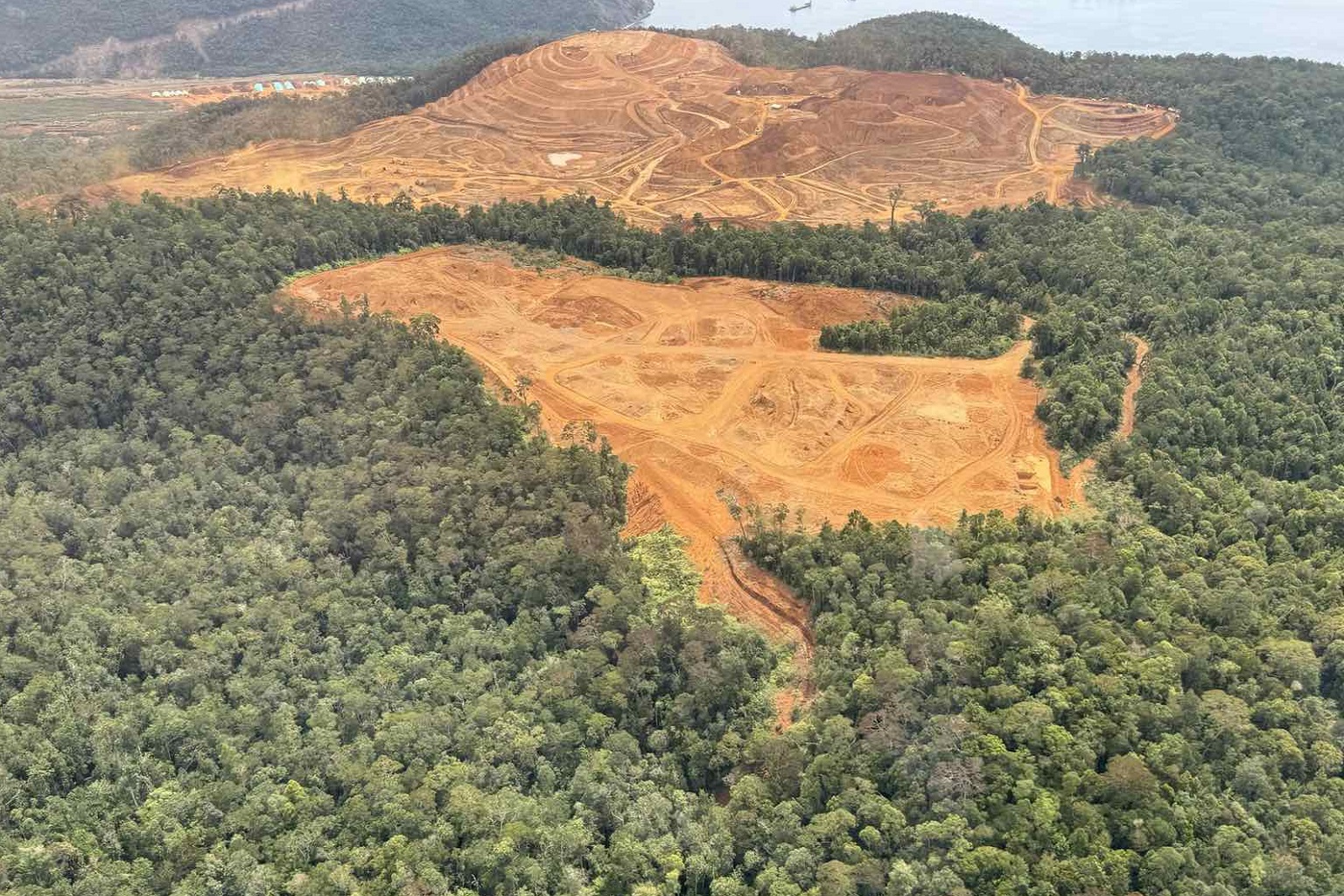
These are not isolated grievances. In December 2023, watchdog analysis found that more than a quarter of the country's transitional mining projects overlap statutory protected forest — a structural collision between "extract the metal" and "keep the forest" that keeps environmental groups, companies, and the state in permanent friction.
Under Philippine law, any project on ancestral domain requires the Free, Prior and Informed Consent (FPIC) of the Indigenous community. In practice, at sites like Brooke's Point, Pala'wan residents report being barely consulted. Companies routinely claim "majority Indigenous support" and point to royalty payments, but uneven benefit-sharing and the desecration of sacred ground fuel bitter internal division.
"Money will not last forever, unlike our irreplaceable Mother Earth." — Davao Oriental Governor Nelson Dayanghirang, ordering a halt to the Pujada mine, Oct 2025
Defending land here is dangerous work. The Philippines has repeatedly ranked as the deadliest country in Asia for land and environmental defenders. Activists and community leaders face intimidation, fabricated criminal charges (SLAPP suits aimed at public participation), and "red-tagging" — being branded communist sympathizers, a label that carries lethal risk. In 2024, village leader Alberto Cuartero was gunned down in Surigao del Sur after testifying in court against a nickel company.
The workforce fares little better. Mining firms tout job creation, but frontline laborers surveyed described wages below the statutory minimum, and — because pits shut during the rainy season to guard against landslides — months of zero income that deepen household debt and poverty.
The reputational damage does not stay onshore. It travels up the supply chain and, in a bitter feedback loop, locks a ceiling onto what Philippine nickel can earn.
As Western automakers (Tesla, GM and others) tighten ESG diligence, ore tainted by documented ecological harm and rights abuses risks being screened out of premium supply chains. The pull is real: refined Philippine nickel-cobalt product flows via Japanese processors toward battery makers supplying Tesla and Toyota, and any credible abuse finding threatens that route. Transparency pressure forces miners to spend more on compliance and community development — or lose access.
Regulatory uncertainty, clashing local bans (five provinces including South Cotabato have their own open-pit prohibitions), and punishing power costs — electricity runs about 30% of manufacturing cost — make it nearly impossible for the Philippines to attract the tens of billions in heavy-industry investment that built Indonesia's HPAL and RKEF refining ecosystem. Today the Philippines operates just two HPAL plants, and in one, Nickel Asia holds only a 10% minority stake. The bulk of low-grade ore leaves as low-value raw material, bound mainly for China and Indonesia.
Each red node is a state or conflict shock that raised the industry's political-risk premium. The 2026 Cebu pact is an attempt to reclaim pricing power from the top — while the ground-level red lines keep tightening from below.
First shipment in the late 1970s. Later decades of disciplined environmental spend earn a national management prize (2016).
Nineteen of the closed operations are nickel producers. National output loses more than 100,000 tonnes on a ministerial signature.
Nickel Asia's Hinatuan Mining Corporation is among the closures. The order is later softened, but the reputational damage sets in.
Cleared mangroves and hillside forest turn a storm into a compound disaster. Red laterite slurry poisons the bay. Displacement lingers for years.
Hundreds of Pala'wan tribespeople resist an operation they say extracts without full permits. Downstream rice paddies smothered by red mud.
The environmental and human-rights red lines are shown to be the same line — a structural collision built into permit geography.
The Philippines is repeatedly ranked the deadliest country in Asia for land and environmental defenders.
Governor Nelson Dayanghirang: "Money will not last forever, unlike our irreplaceable Mother Earth."
An attempt to steer the 74–75% of global supply the two nations command — even as LFP batteries, sodium-ion, and >95% recycling erode nickel's premium from below.
The deepening environmental and human-rights crisis in Philippine nickel has outgrown the category of "social responsibility." It is now the hand at the throat of the country's move up the value chain and its bid for genuine resource sovereignty.
In a landscape of weak enforcement and a patchwork of provincial bans, an operator unwilling to shoulder the real cost of ESG compliance is left spinning inside a single vicious circle: forest cleared → climate disaster → conflict ignites → state intervention — and back to shipping cheap raw ore as the world's quarry.
Whether the Philippines can enforce the environmental laws already on its books, honor Indigenous rights in practice rather than paperwork, and improve the lot of mine labor is therefore not only a moral test. It is the decisive judgment on whether the country breaks out as a real player in the 21st-century green-industrial contest — or watches its trillion-dollar endowment leave, one red shipload at a time.
The ceiling on Philippine nickel is not in the ground.
It is in the governance.